INSIGHTS
How the firm is put together
Where our attorneys come from, what our AI actually does, which markets we cover, and why the fee model needs all three.
PUBLISHED
CATEGORY
Company news

Most descriptions of an AI law firm skip the part that matters, which is how the firm itself is assembled. Here is ours.
It is a law firm, not a tool
This is the load bearing distinction. A legal AI product analyses your contract and hands the decision back to you, which means you still need an attorney to make it. Moritz is a law firm. A licensed attorney reviews the work, negotiates it, and signs off on it, and carries the professional obligations that go with doing so.
That difference shows up in the things you can actually rely on: a named person accountable for the matter, the duty of confidentiality a regulated firm owes you, and advice you can act on rather than a flag you have to interpret.
The attorneys
Our attorneys come from firms including Orrick, Cooley, Fenwick and Goodwin. That background is the point rather than a credential: the work we take on is the work those firms do, and the reason it can be priced differently is not that the attorneys are more junior.
The split
Our AI workflows handle around 80% of a matter. Intake, first drafts, quality assurance, running the document against your playbook and the legal database. The remaining 20% is the part that needs judgment: what to concede, what to hold, what a clause will mean in eighteen months when somebody wants out.
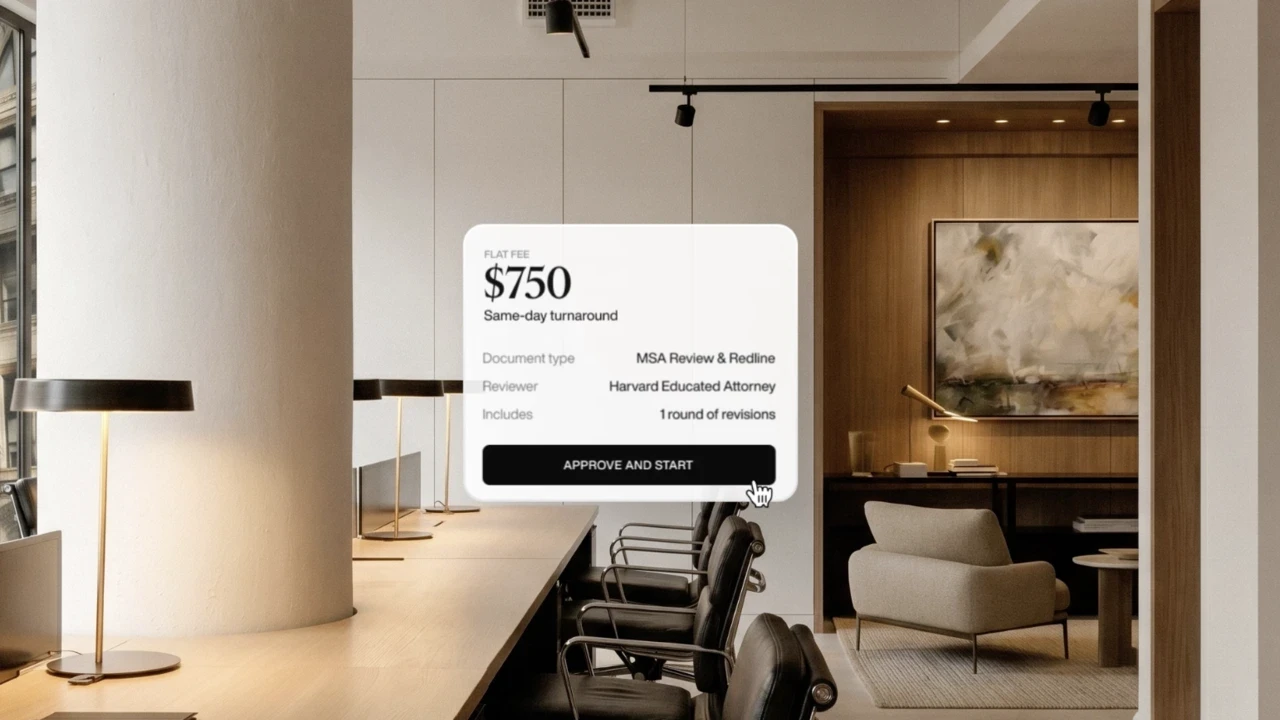
That is what you are paying for, and it is why a $750 contract review is not a contradiction. You are not buying AI output. You are buying elite attorneys for the final 20%, at a price the first 80% makes possible.
The reach
Companies do not stop at a border and neither does the paper they sign. We handle product compliance and contract work across the EU, the US and Australia, so a team does not need a separate relationship in every market it sells into.
The commercial model
Flat fees, quoted before work starts, published as a rate table rather than quoted on request. No retainer, no hourly billing, no invoice that arrives after the close and surprises somebody. Same day turnaround on standard matters.
None of this is possible as a bolt on to an hourly firm, which is why the firm was built from scratch rather than converted. Speaking to Sifted, our cofounder Pamir Ehsas described the ambition plainly: “We’re building the world’s largest global law firm from scratch”.
Where to look next
The five steps show how a matter actually moves through the firm. The rate table is public. Our position on confidentiality, privilege and how client data is handled is set out on the security page, and the coverage of our funding round is collected in Moritz in the news.
INSIGHTS
See other articles

Moritz raises $9M
An oversubscribed round closed in four days, led by Y Combinator and 20VC, to build a law firm that works at company speed.

Moritz in the news
Where our funding round was covered across the technology and legal trade press, and what each piece adds.
Why we quote a flat fee before we start
Hourly billing hands you the price only after you have committed. Here is what agreeing it first changes.
" height="94.16734885253905px" id="orcW2rWL3" transform="translate(4.133 6.752)" width="348.40327789306633px"/><path d="M 7.462 14.662 C 3.279 14.662 0 11.646 0 7.35 C 0 3.091 3.279 0 7.462 0 C 11.721 0 15 3.091 15 7.35 C 15 11.646 11.721 14.662 7.462 14.662 Z M 7.462 13.757 C 11.156 13.757 14.02 11.119 14.02 7.35 C 14.02 3.581 11.156 0.905 7.462 0.905 C 3.769 0.905 0.979 3.581 0.979 7.35 C 0.979 11.119 3.769 13.757 7.462 13.757 Z M 10.063 11.571 C 9.912 11.571 9.837 11.533 9.761 11.42 L 7.801 8.179 C 7.387 7.5 7.198 7.387 6.595 7.387 C 6.445 7.387 6.369 7.387 6.218 7.425 L 6.218 10.516 C 6.218 11.043 6.407 11.269 6.859 11.269 L 6.935 11.269 C 7.048 11.307 7.085 11.345 7.085 11.42 C 7.085 11.496 7.01 11.571 6.935 11.571 L 4.032 11.571 C 3.957 11.571 3.882 11.496 3.882 11.42 C 3.882 11.345 3.957 11.307 4.032 11.269 L 4.108 11.269 C 4.56 11.269 4.786 11.043 4.786 10.516 L 4.786 3.731 C 4.786 3.166 4.56 3.015 4.108 2.977 L 4.032 2.977 C 3.957 2.977 3.882 2.94 3.882 2.827 C 3.882 2.751 3.957 2.714 4.032 2.714 L 5.502 2.714 C 6.143 2.714 6.746 2.638 7.311 2.638 C 9.611 2.638 10.591 3.618 10.591 4.824 C 10.591 6.068 9.611 6.897 8.178 7.123 C 8.668 7.274 8.97 7.576 9.347 8.141 L 11.005 10.553 C 11.269 11.006 11.684 11.269 12.023 11.269 C 12.098 11.269 12.136 11.345 12.136 11.42 C 12.136 11.496 12.098 11.571 12.023 11.571 Z M 6.972 6.784 C 8.291 6.784 9.045 6.181 9.045 4.975 C 9.045 3.882 8.367 3.241 7.274 3.241 C 7.048 3.241 6.859 3.241 6.595 3.279 C 6.294 3.354 6.218 3.43 6.218 3.769 L 6.218 6.784 C 6.482 6.784 6.708 6.784 6.972 6.784 Z" fill="rgb(255, 255, 255)" height="14.6616px" id="SBmyBVvRn" transform="translate(354.855 41.323)" width="15px"/></svg>)
