INSIGHTS
What happens if a matter turns out bigger than we scoped
A flat fee is fixed against a scope, not a wish. Here is what moves it, what does not, and why we pause rather than invoice.
PUBLISHED
CATEGORY
Pricing
A flat fee only means something if it holds. Otherwise it is an estimate wearing a better suit, and everyone has been burned by one of those.
So it is worth being precise about what our fee is fixed against, and what happens on the days it does not fit.
The fee is fixed against a scope, not against a wish
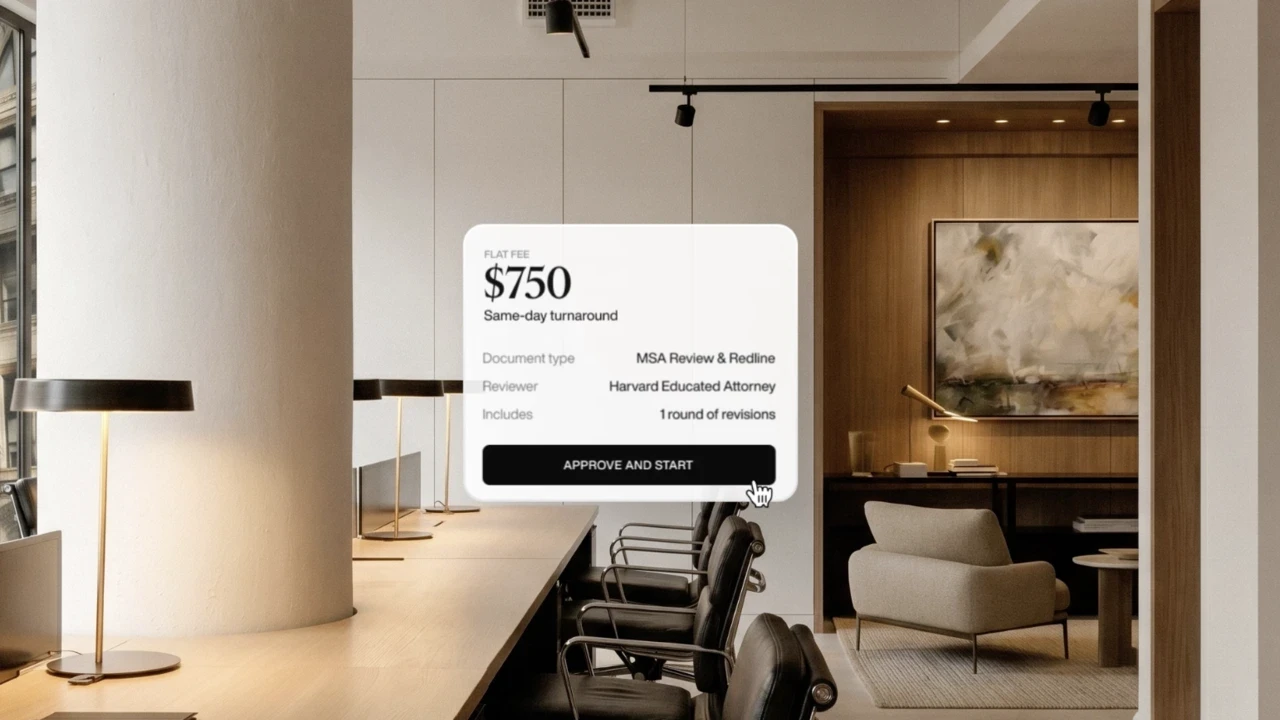
When you send us a matter, we read it before we price it. The quote comes back attached to a specific piece of work: this agreement, this side of the paper, this length. Our rate table is public, so you can see roughly where you will land before you send anything: $750 for a commercial contract up to 30 pages on your paper, $1,500 for third party paper or a longer document on yours, $2,500 for both at once.
Once you approve that number, it does not move. Not when the counterparty comes back with a full markup. Not when the negotiation runs three rounds instead of one. Not when the close date slips and the whole thing sits for a month. One price before work begins, however long the negotiation runs.
What counts as a material change
Sometimes the matter you describe and the matter that arrives are different things. A review turns out to sit on top of a master agreement nobody mentioned. A 20 page document arrives at 60. A contract review turns into a question about how the whole vendor relationship is structured.
When that happens we stop and tell you before we continue. The original fee stands for the original scope, and you approve any new number before we do the extra work. What we do not do is keep working and settle up at the end, which is the mechanism that makes hourly billing feel like a trap.
It follows that the pause is a feature and not an inconvenience. The moment a firm can absorb extra scope quietly, the incentive to tell you about it disappears.
The direction of travel
There is one more thing a fixed fee should not mean, which is fixed forever. Our AI does around 80% of the work on a matter. As that technology gets cheaper, our prices fall with it. We put that in writing on our pricing page because very few firms are structured in a way that lets them make the promise at all: when your cost base is people billing hours, cheaper technology improves your margin, not your client’s invoice.
What this looks like in practice
You see the number first. No matter starts without an approved fee.
Revisions do not add to it. The negotiation is the work, not an extra.
Scope changes are a conversation, not an invoice. We pause, we explain, you decide.
Anything outside the rate table gets quoted the same way. Other matters are priced flat, typically around half of standard market rates.
The full rate table is on our pricing page, and the questions we get asked most are answered there too. If your work does not look like anything in the table, describe it and we will quote it.
INSIGHTS
See other articles

Moritz raises $9M
An oversubscribed round closed in four days, led by Y Combinator and 20VC, to build a law firm that works at company speed.

Moritz in the news
Where our funding round was covered across the technology and legal trade press, and what each piece adds.
Why we quote a flat fee before we start
Hourly billing hands you the price only after you have committed. Here is what agreeing it first changes.
" height="94.16734885253905px" id="orcW2rWL3" transform="translate(4.133 6.752)" width="348.40327789306633px"/><path d="M 7.462 14.662 C 3.279 14.662 0 11.646 0 7.35 C 0 3.091 3.279 0 7.462 0 C 11.721 0 15 3.091 15 7.35 C 15 11.646 11.721 14.662 7.462 14.662 Z M 7.462 13.757 C 11.156 13.757 14.02 11.119 14.02 7.35 C 14.02 3.581 11.156 0.905 7.462 0.905 C 3.769 0.905 0.979 3.581 0.979 7.35 C 0.979 11.119 3.769 13.757 7.462 13.757 Z M 10.063 11.571 C 9.912 11.571 9.837 11.533 9.761 11.42 L 7.801 8.179 C 7.387 7.5 7.198 7.387 6.595 7.387 C 6.445 7.387 6.369 7.387 6.218 7.425 L 6.218 10.516 C 6.218 11.043 6.407 11.269 6.859 11.269 L 6.935 11.269 C 7.048 11.307 7.085 11.345 7.085 11.42 C 7.085 11.496 7.01 11.571 6.935 11.571 L 4.032 11.571 C 3.957 11.571 3.882 11.496 3.882 11.42 C 3.882 11.345 3.957 11.307 4.032 11.269 L 4.108 11.269 C 4.56 11.269 4.786 11.043 4.786 10.516 L 4.786 3.731 C 4.786 3.166 4.56 3.015 4.108 2.977 L 4.032 2.977 C 3.957 2.977 3.882 2.94 3.882 2.827 C 3.882 2.751 3.957 2.714 4.032 2.714 L 5.502 2.714 C 6.143 2.714 6.746 2.638 7.311 2.638 C 9.611 2.638 10.591 3.618 10.591 4.824 C 10.591 6.068 9.611 6.897 8.178 7.123 C 8.668 7.274 8.97 7.576 9.347 8.141 L 11.005 10.553 C 11.269 11.006 11.684 11.269 12.023 11.269 C 12.098 11.269 12.136 11.345 12.136 11.42 C 12.136 11.496 12.098 11.571 12.023 11.571 Z M 6.972 6.784 C 8.291 6.784 9.045 6.181 9.045 4.975 C 9.045 3.882 8.367 3.241 7.274 3.241 C 7.048 3.241 6.859 3.241 6.595 3.279 C 6.294 3.354 6.218 3.43 6.218 3.769 L 6.218 6.784 C 6.482 6.784 6.708 6.784 6.972 6.784 Z" fill="rgb(255, 255, 255)" height="14.6616px" id="SBmyBVvRn" transform="translate(354.855 41.323)" width="15px"/></svg>)
