INSIGHTS
What attorney review actually means
“Human in the loop” covers everything from an optional spot check to a signature someone is accountable for.
PUBLISHED
CATEGORY
How we work
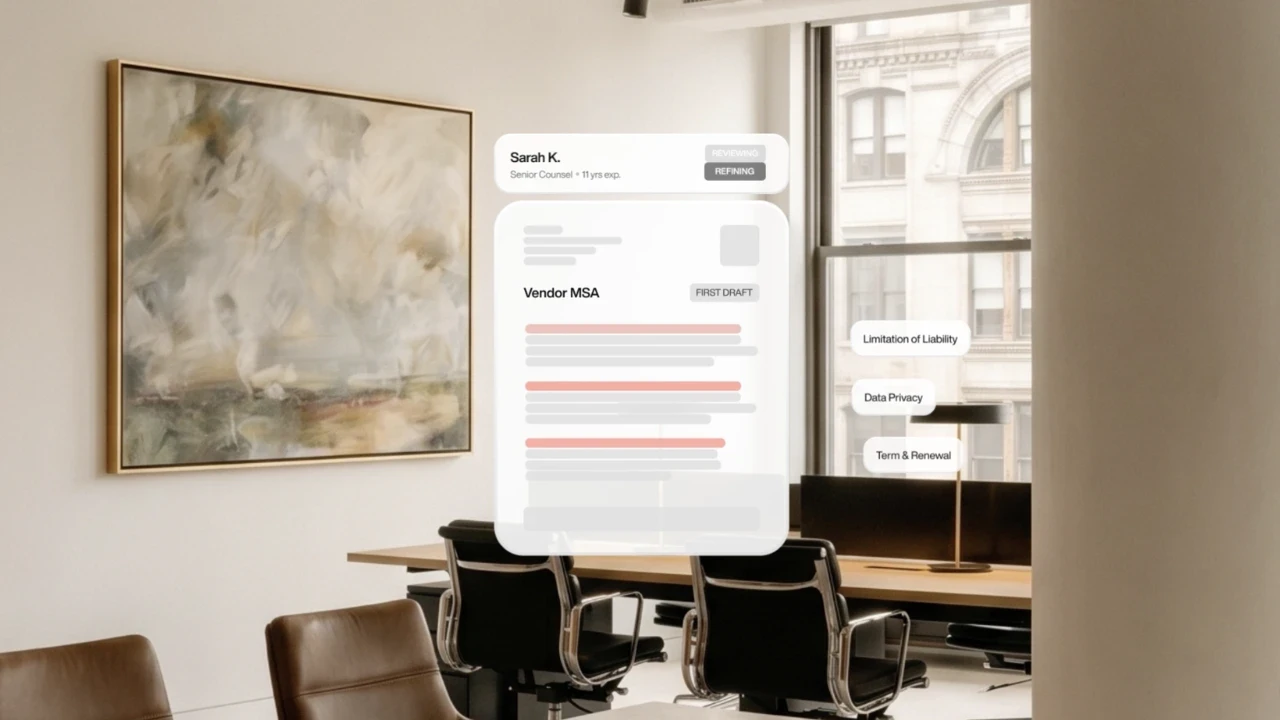
The counterparty has moved the liability cap from twelve months of fees to a fixed number, added a carve-out nobody asked for, and left the indemnity alone. Your review tool caught all three and proposed replacement language for each. Someone still has to decide whether to accept them, and hold that position on the call tomorrow morning. Until that happens, nothing has actually been reviewed.
Almost every legal AI product now says it keeps a human in the loop. Very few say which human, at which point, obliged to do what. That vagueness is doing a lot of work, because the phrase covers at least four arrangements, and they leave the risk in four different places.
Four things “human in the loop” can mean
You are the loop. The tool produces output and a person may review it. That person is you, at whatever hour it arrives. Nothing has moved off your desk except the typing.
Someone samples it. The vendor reviews a share of outputs for quality. That is a product metric. It says something about the system over time and nothing about the document in front of you.
A subject-matter expert checks it. Often genuinely good work. But an expert who is not a licensed attorney owes you what the contract says, and nothing beyond it.
A named, licensed attorney reviews every deliverable and stands behind it. Only this version moves the risk, because only this version carries professional obligations with it.
What the license actually obliges
An attorney acting as your attorney is bound by professional conduct rules, not only by a commercial agreement. Three consequences follow.
Judgment is owed, not just detection. A tool flags a clause. It cannot decide it, negotiate it or stand behind it. Spotting an uncapped indemnity is pattern recognition. Deciding whether to accept it, given this counterparty and your own escalation triggers, is a legal judgment, and someone has to be answerable for making it.
Privilege attaches to attorneys, not to software. A vendor can promise confidentiality by contract. An attorney owes it as a professional duty, and privilege comes with it. The difference is not rhetorical: confidentiality is a promise you can sue on once it is broken, while attorney-client privilege protects the work from being compelled out of you in the first place. A subscription gives you the first. Only a law firm gives you the second.
Someone carries the liability. Read the limitation-of-liability clause before you read the marketing page. If the answer to “who is responsible when this is wrong” is a capped refund, review is a feature. If it is a named attorney at a regulated firm, review is a duty.
Questions worth asking any vendor
Who reviewed this, by name? If you cannot see the matter, its status and its attorney, review is a claim rather than a record.
Is review mandatory on every deliverable, or sampled? Ask for the rule, not the average.
Is that person licensed, and where? Cross-border work is where this quietly breaks. An attorney admitted in one jurisdiction is not an attorney everywhere your contracts land.
Does privilege attach, or only confidentiality? A software vendor cannot give you the first, whatever its security page says.
Can they negotiate, or only flag? Review that stops at the redline leaves the hardest part with you: the call, the concession, the position you have to hold.
What happens when the answer is wrong? Every other question is a proxy for this one.
Where we draw the line
Every matter runs the same way. Our AI workflows do 80% of the work, and an experienced attorney takes the final 20%, which is deciding the clause, negotiating it and signing off on it. A named, licensed attorney quality-assures every deliverable before it reaches you. We are a law firm rather than a software vendor, so privilege attaches to the work, and a named attorney is accountable for every matter.
You do not need to buy any of that to use the questions above. Ask them of everyone, us included. A good answer is specific and slightly boring. A vague answer is itself the answer.
INSIGHTS
See other articles

Moritz raises $9M
An oversubscribed round closed in four days, led by Y Combinator and 20VC, to build a law firm that works at company speed.

Moritz in the news
Where our funding round was covered across the technology and legal trade press, and what each piece adds.

Why we quote a flat fee before we start
Hourly billing hands you the price only after you have committed. Here is what agreeing it first changes.
" height="94.16734885253905px" id="orcW2rWL3" transform="translate(4.133 6.752)" width="348.40327789306633px"/><path d="M 7.462 14.662 C 3.279 14.662 0 11.646 0 7.35 C 0 3.091 3.279 0 7.462 0 C 11.721 0 15 3.091 15 7.35 C 15 11.646 11.721 14.662 7.462 14.662 Z M 7.462 13.757 C 11.156 13.757 14.02 11.119 14.02 7.35 C 14.02 3.581 11.156 0.905 7.462 0.905 C 3.769 0.905 0.979 3.581 0.979 7.35 C 0.979 11.119 3.769 13.757 7.462 13.757 Z M 10.063 11.571 C 9.912 11.571 9.837 11.533 9.761 11.42 L 7.801 8.179 C 7.387 7.5 7.198 7.387 6.595 7.387 C 6.445 7.387 6.369 7.387 6.218 7.425 L 6.218 10.516 C 6.218 11.043 6.407 11.269 6.859 11.269 L 6.935 11.269 C 7.048 11.307 7.085 11.345 7.085 11.42 C 7.085 11.496 7.01 11.571 6.935 11.571 L 4.032 11.571 C 3.957 11.571 3.882 11.496 3.882 11.42 C 3.882 11.345 3.957 11.307 4.032 11.269 L 4.108 11.269 C 4.56 11.269 4.786 11.043 4.786 10.516 L 4.786 3.731 C 4.786 3.166 4.56 3.015 4.108 2.977 L 4.032 2.977 C 3.957 2.977 3.882 2.94 3.882 2.827 C 3.882 2.751 3.957 2.714 4.032 2.714 L 5.502 2.714 C 6.143 2.714 6.746 2.638 7.311 2.638 C 9.611 2.638 10.591 3.618 10.591 4.824 C 10.591 6.068 9.611 6.897 8.178 7.123 C 8.668 7.274 8.97 7.576 9.347 8.141 L 11.005 10.553 C 11.269 11.006 11.684 11.269 12.023 11.269 C 12.098 11.269 12.136 11.345 12.136 11.42 C 12.136 11.496 12.098 11.571 12.023 11.571 Z M 6.972 6.784 C 8.291 6.784 9.045 6.181 9.045 4.975 C 9.045 3.882 8.367 3.241 7.274 3.241 C 7.048 3.241 6.859 3.241 6.595 3.279 C 6.294 3.354 6.218 3.43 6.218 3.769 L 6.218 6.784 C 6.482 6.784 6.708 6.784 6.972 6.784 Z" fill="rgb(255, 255, 255)" height="14.6616px" id="SBmyBVvRn" transform="translate(354.855 41.323)" width="15px"/></svg>)
