INSIGHTS
Whose paper should you work from
Working from your form or theirs changes your leverage, your review time and your price before a clause is discussed.
PUBLISHED
CATEGORY
Contracts

The commercial terms are agreed. Then someone on the other side attaches “our standard MSA” and asks you to mark it up. Before you open it there is a decision worth thirty seconds of thought: do you redline their document, or send back your own form and ask them to work from that?
It looks like a formality. It is one of the few choices in a negotiation that moves your leverage, your review time and your price at once, and it gets made before a single clause is discussed.
What your own paper buys you
Whoever drafts sets the defaults. Every position in the document is yours until the other side notices it, objects to it and argues it out. That is a real transfer of effort: they carry the burden of raising each deviation, and the clauses nobody argues about stay where you put them.
The second advantage is speed. You already know the form, so review is limited to what changed and the risk sits in the redlines rather than in the whole document. The third is consistency. Run SOWs and order forms against your own playbook and the terms hold as you scale, instead of drifting one negotiation at a time.
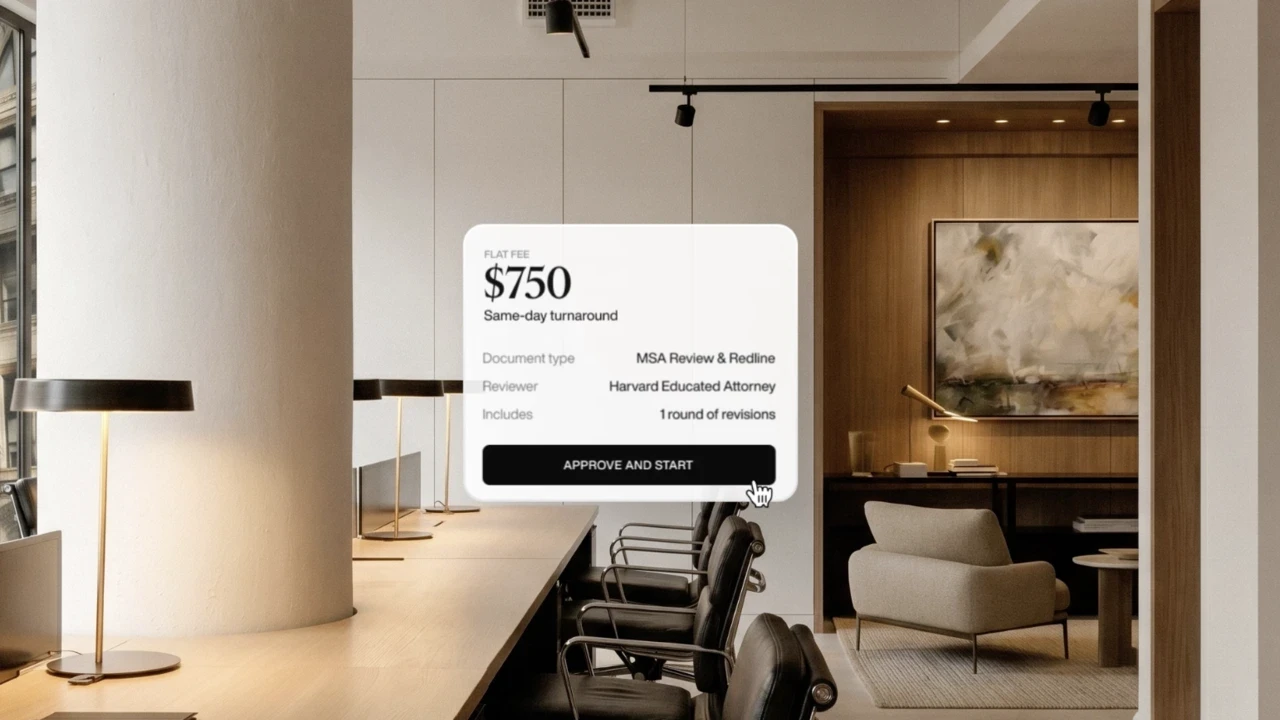
It is also the cheapest line on our rate table: a commercial contract up to 30 pages, on your paper, is $750.
What the counterparty’s paper costs you
Third-party paper takes more care, and the care is not optional. You are reading a document drafted to someone else’s advantage, so nothing can be skimmed on the assumption that it says what it usually says. The definitions are theirs. The liability cap may be qualified three sections away. The indemnity that matters may sit in a schedule. Familiar headings can carry unfamiliar terms.
You are also negotiating uphill. On their form every change you want is a request; on yours, every change they want is. Same clause, opposite burden, and the difference shows up in how many rounds it takes to reach signature.
So the price reflects the work rather than averaging it away. Third-party paper up to 30 pages sits at $1,500, the same tier as your own paper once it passes 30 pages. Past 30 pages on their form it is $2,500.
When to insist, and when to let it go
Insist on your own form where the paper repeats. NDAs, SOWs, order forms, contractor agreements, anything you will sign twenty more times this year. Consistency compounds there, and every hour spent hardening the template is repaid across the whole queue. Insist as well where you carry the operational risk. If you are the one performing, hosting the data or delivering the service, the document should start from your view of what can go wrong.
Let it go when the fight costs more than the clause. If the counterparty is an enterprise whose procurement process will not accept vendor paper, if the contract value is small, or if the argument puts the close date at risk, take their form and spend your leverage on the terms that actually decide the outcome: liability, indemnities, IP ownership, data, termination. Winning the form and losing the cap is not a win.
One test settles most of the borderline cases. If you cannot say what your position on a clause is, your own paper buys you very little. A template you cannot defend is someone else’s template with your name on it.
Either way, price it before you start
The choice only becomes expensive when its cost surfaces afterwards. Billed by the hour, your paper and their paper look identical at the outset and differ only on the invoice, which is the one moment the information is no longer useful.
We quote per matter, and whose paper it is forms part of the quote alongside the page count. Yours or theirs, we draft, redline and negotiate commercial contracts to signature, with a named attorney running the document against your positions, usually the same day.
INSIGHTS
See other articles

Moritz raises $9M
An oversubscribed round closed in four days, led by Y Combinator and 20VC, to build a law firm that works at company speed.

Moritz in the news
Where our funding round was covered across the technology and legal trade press, and what each piece adds.
Why we quote a flat fee before we start
Hourly billing hands you the price only after you have committed. Here is what agreeing it first changes.
" height="94.16734885253905px" id="orcW2rWL3" transform="translate(4.133 6.752)" width="348.40327789306633px"/><path d="M 7.462 14.662 C 3.279 14.662 0 11.646 0 7.35 C 0 3.091 3.279 0 7.462 0 C 11.721 0 15 3.091 15 7.35 C 15 11.646 11.721 14.662 7.462 14.662 Z M 7.462 13.757 C 11.156 13.757 14.02 11.119 14.02 7.35 C 14.02 3.581 11.156 0.905 7.462 0.905 C 3.769 0.905 0.979 3.581 0.979 7.35 C 0.979 11.119 3.769 13.757 7.462 13.757 Z M 10.063 11.571 C 9.912 11.571 9.837 11.533 9.761 11.42 L 7.801 8.179 C 7.387 7.5 7.198 7.387 6.595 7.387 C 6.445 7.387 6.369 7.387 6.218 7.425 L 6.218 10.516 C 6.218 11.043 6.407 11.269 6.859 11.269 L 6.935 11.269 C 7.048 11.307 7.085 11.345 7.085 11.42 C 7.085 11.496 7.01 11.571 6.935 11.571 L 4.032 11.571 C 3.957 11.571 3.882 11.496 3.882 11.42 C 3.882 11.345 3.957 11.307 4.032 11.269 L 4.108 11.269 C 4.56 11.269 4.786 11.043 4.786 10.516 L 4.786 3.731 C 4.786 3.166 4.56 3.015 4.108 2.977 L 4.032 2.977 C 3.957 2.977 3.882 2.94 3.882 2.827 C 3.882 2.751 3.957 2.714 4.032 2.714 L 5.502 2.714 C 6.143 2.714 6.746 2.638 7.311 2.638 C 9.611 2.638 10.591 3.618 10.591 4.824 C 10.591 6.068 9.611 6.897 8.178 7.123 C 8.668 7.274 8.97 7.576 9.347 8.141 L 11.005 10.553 C 11.269 11.006 11.684 11.269 12.023 11.269 C 12.098 11.269 12.136 11.345 12.136 11.42 C 12.136 11.496 12.098 11.571 12.023 11.571 Z M 6.972 6.784 C 8.291 6.784 9.045 6.181 9.045 4.975 C 9.045 3.882 8.367 3.241 7.274 3.241 C 7.048 3.241 6.859 3.241 6.595 3.279 C 6.294 3.354 6.218 3.43 6.218 3.769 L 6.218 6.784 C 6.482 6.784 6.708 6.784 6.972 6.784 Z" fill="rgb(255, 255, 255)" height="14.6616px" id="SBmyBVvRn" transform="translate(354.855 41.323)" width="15px"/></svg>)
